
Edit intensity: Light — H2 keyword insertions, primary keyword placed in first 100 words, internal links inserted at confirmed URLs, secondary keywords distributed naturally. No structural or voice changes.
Your business continuity plan exists. It is formatted correctly, contains the right headings, assigns roles, and describes activation procedures. It passed the last surveillance audit without a finding. None of that means it will work when you need it — and understanding why requires examining what ISO 22301 Clause 8.4 actually demands of plan documentation and the analytical chain that must precede it.
ISO 22301:2019 structures its Clause 8 requirements as a linear dependency chain. Business impact analysis (8.2.2) produces recovery time objectives and resource requirements. Risk assessment (8.2.3) identifies disruption risks to prioritised activities. Strategy selection (8.3) determines how the organisation will protect and recover those activities within the constraints set by the BIA. Only then does Clause 8.4 require the organisation to document business continuity plans — plans that must be, in the standard’s own language, “based on the output of the selected strategies and solutions.”
Organisations that start with the plan bypass this chain entirely. The result is a BCMS that satisfies document review but cannot survive its own exercise programme.
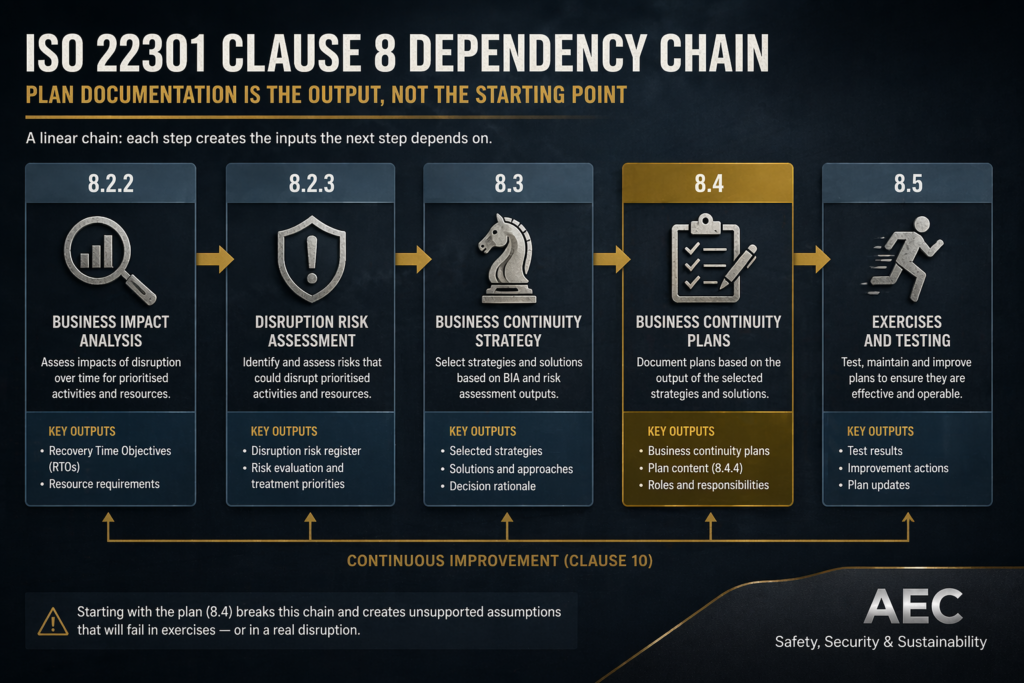
The ISO 22301 Clause 8 Dependency Chain
Understanding why plan-centric approaches fail requires reading Clauses 8.2 through 8.5 as a sequence, not as independent requirements to be addressed in any order.
Clause 8.2.2 mandates that the organisation conduct a business impact analysis that, among other outputs, sets prioritised time frames for resuming disrupted activities at a specified minimum acceptable capacity. These are the recovery time objectives. The clause also requires the organisation to determine resource requirements for supporting the continuity and recovery of prioritised activities. These outputs are not optional inputs to subsequent clauses — they are the analytical foundation the entire BCMS rests on.
Clause 8.2.3 then requires risk assessment scoped specifically to disruption risks affecting prioritised activities and their required resources. This is not a duplicate of the management system risk assessment required under Clause 6.1. It is an operational risk assessment that identifies what can disrupt the activities the BIA has prioritised, and evaluates which of those risks require treatment.
Clause 8.3.1 closes the analytical phase: the organisation must identify and select business continuity strategies “based on the outputs from the business impact analysis and risk assessment.” Strategy selection is where the organisation decides how it will protect and recover — alternative sites, supplier diversification, technology redundancy, staffing arrangements. These decisions must be traceable to the disruption risks and recovery constraints identified upstream.
Only at Clause 8.4.1 does plan documentation enter the picture. Plans must be “based on the output of the selected strategies and solutions.” This is not a procedural suggestion. It establishes ISO 22301 Clause 8.4 as an output clause — the point where analytical decisions are translated into operational documentation.
Clause references reflect mapped standard requirements from ISO 22301:2019. Verify against current edition before audit use.
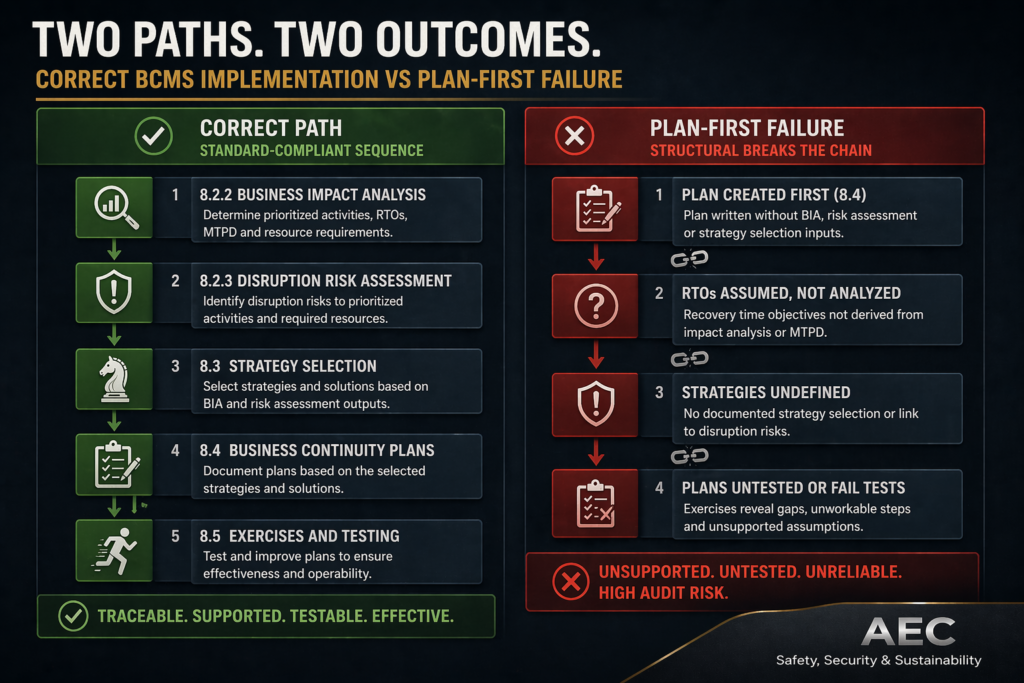
Where BCMS Implementations Fail
The most common failure mode is direct: organisations start at Clause 8.4 and work backwards — or not at all.
A project team is asked to produce a business continuity plan. They draft a document covering activation procedures, communication trees, role assignments, and recovery steps. The plan looks credible. It uses the right terminology. It may even reference RTOs — but those RTOs were assigned during plan writing, not derived from a structured BIA process that assessed impacts over time and determined the point at which non-resumption becomes unacceptable.
Lead auditor failure compilations consistently identify two patterns at the top of the nonconformity list for ISO 22301. The first is BIA missing or incomplete — organisations skip the BIA entirely or treat it as a checklist exercise where impact categories are vague and RTOs are not clearly defined. The second is no documented business continuity strategy — organisations proceed directly from whatever limited BIA exists to plan documentation, bypassing the strategy selection step where decisions about protection and recovery approaches are made and resourced.
These are not obscure findings. They are the first and second most frequently cited audit failures because they represent the structural foundation of the BCMS. When the foundation is absent, every downstream output is unsupported.
Document review will not catch this. An auditor reviewing plan documentation against ISO 22301 Clause 8.4 requirements can confirm the plan exists, contains the required elements (Clause 8.4.4 specifies content requirements), and is maintained. The disconnect between plan content and upstream analytical outputs is only exposed during exercise testing (Clause 8.5) or during actual disruption, which is where the cost is real.
What an Audit-Defensible BCMS Looks Like
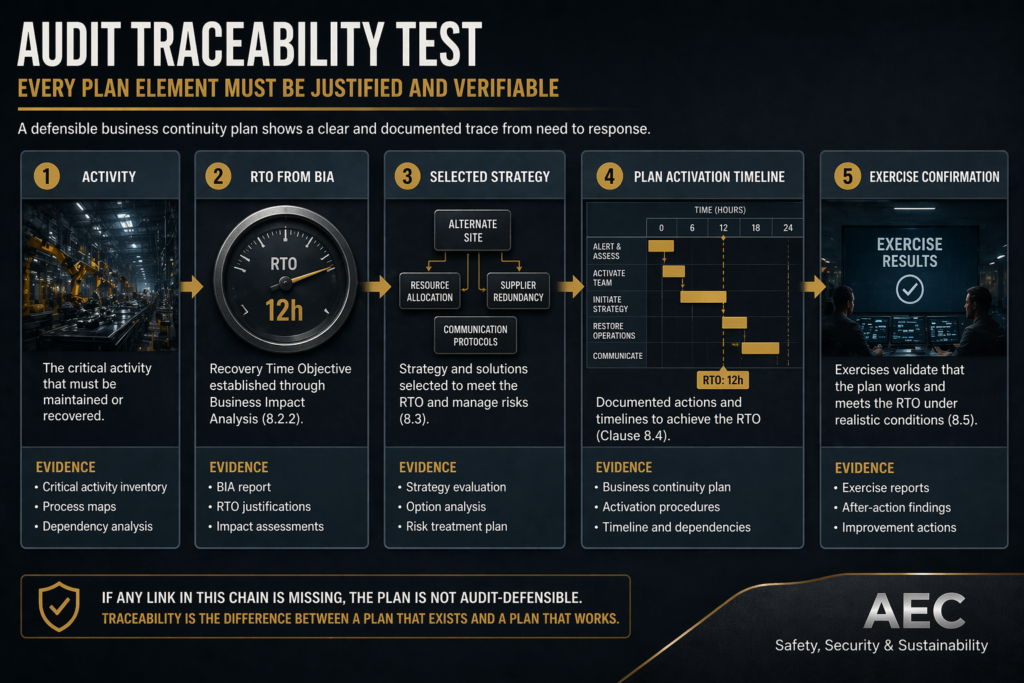
An audit-defensible BCMS is one where the traceability from BIA output to plan content is explicit and documented.
This means the BIA (8.2.2) produces RTOs per prioritised activity — not generic numbers assigned to broad categories, but time-bound recovery targets derived from assessed impact over time, with the maximum tolerable period of disruption (MTPD) established as the outer constraint. Each RTO must be demonstrably less than the corresponding MTPD, providing a recovery margin.
The risk assessment (8.2.3) then identifies specific disruption threats to each prioritised activity and its required resources. The output feeds strategy selection (8.3), where the organisation commits to specific protection and recovery approaches — and resources them.
Plan documentation (8.4) then translates those strategy decisions into operational procedures. The activation timeline in the plan for a given activity must be consistent with the RTO established in the BIA. The resource mobilisation steps must reflect the resource requirements identified in the BIA and the protection arrangements selected in the strategy.
The test: an auditor or exercise controller picks any prioritised activity, traces its RTO from the BIA, identifies the strategy selected to meet that RTO, and finds the corresponding activation and recovery procedure in the plan with a timeline that fits within the RTO envelope.
If that trace cannot be completed, the plan is a document, not a tested capability.
Practical Steps for ISO 22301 Clause 8.4 Compliance
Start with Clause 8.2.2, not Clause 8.4. Conduct the BIA first. Identify prioritised activities, assess impacts over time, establish MTPDs, and derive RTOs. Do not assign RTOs without completing the impact assessment that justifies them.
Scope the risk assessment (8.2.3) to BIA outputs. The disruption risks you assess must be scoped to the prioritised activities and resources identified in the BIA — not to the management system broadly. Use the output to identify which risks require treatment through business continuity strategies.
Document strategy selection (8.3) as a decision record. For each prioritised activity, record the strategy selected, the resources committed, and the rationale linking the strategy to the BIA-derived RTO. This decision record is the bridge between analysis and plan.
Write plans (8.4) as strategy implementation documents. Every activation timeline, resource mobilisation step, and recovery procedure in the plan should be traceable to a strategy decision, which in turn is traceable to a BIA output. If you cannot trace the line, the plan is not grounded.
Design exercises (8.5) to test the chain, not just the plan. Exercise scenarios should be constructed to test whether plan activation timelines actually meet BIA-derived RTOs under realistic conditions — not whether the team can follow the documented procedure in isolation.
Key Takeaway
ISO 22301 Clause 8.4 is not where a BCMS begins — it is where the upstream analytical work becomes operational documentation. Organisations that start with plans produce documents that satisfy a surveillance document review but fail under exercise testing because there is no traceable line from BIA recovery time objectives through strategy selection to plan activation timelines. That traceability is not optional — it is what the clause chain requires, and it is what separates a compliant BCMS from one that actually recovers.
For organisations preparing for ISO 22301 certification or strengthening an existing BCMS, AEC International’s business continuity certification services support the full implementation cycle — from BIA design through exercise programme development.
About AEC International
AEC International provides ISO certification, training, and consultancy services at the intersection of business continuity, resilience, and operational risk management. We support organisations across industries in achieving and maintaining ISO certification — from gap analysis and implementation through audit preparation and continual improvement.
Learn more: www.aec.llc