
Tag
Gap Analysis
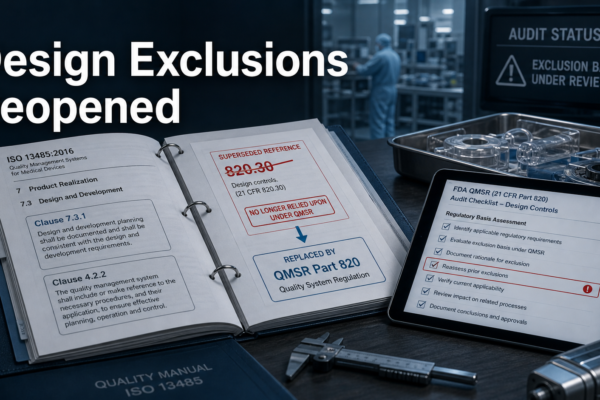
ISO 13485 Clause 7.3 Exclusion: Why Your Design Controls Justification Fails Under the FDA QMSR
Clause 7.3 exclusion under FDA QMSR is no longer a settled historical decision. Contract manufacturers and component suppliers must update ISO 13485 quality manual justifications, reassess design activity boundaries, and prepare current audit evidence.
Read article →
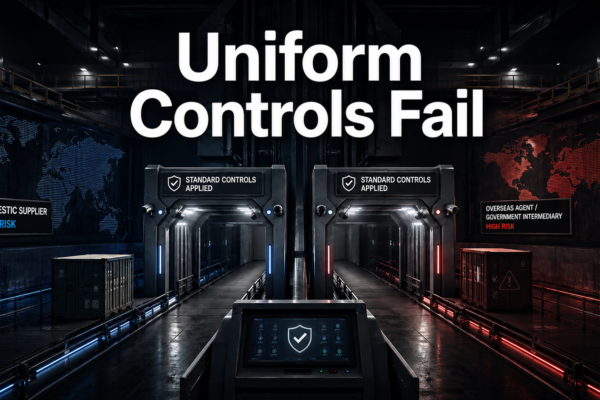
ISO 37001 “Reasonable and Proportionate”: Why Uniform Controls Fail the Standard’s Own Test
Quick Answer: ISO 37001:2025 requires every anti-bribery control to be calibrated to documented bribery risk — not applied uniformly. “Reasonable and proportionate” is a design instruction: risk assessment…
Read article →
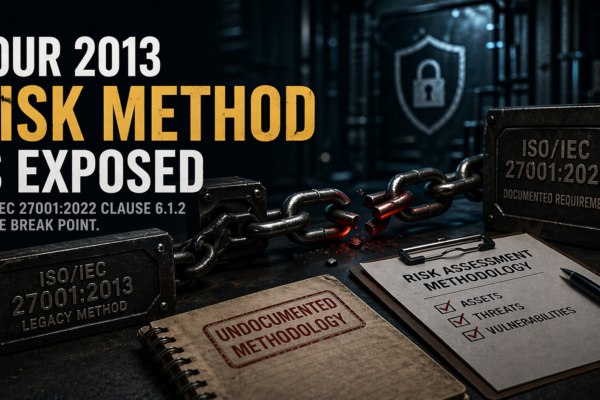
ISO 27001:2022 Clause 6.1.2: Why Your Carried-Forward Risk Assessment Methodology Is an Audit Liability
**Excerpt:** ISO 27001:2022 removed asset/threat/vulnerability as a normative prerequisite for risk identification. Organisations that carried their methodology forward without documenting the choice under Clause 6.1.2 now face a Major nonconformity risk at their next audit. (42 words)
Read article →

ISO 14001 Clause 6.1.2: Why Your Aspect Register’s Life Cycle Perspective Probably Stops Too Soon
Most ISO 14001 aspect registers cover site-boundary operations but omit upstream and downstream life cycle stages without documented rationale. Clause 6.1.2 requires documented consideration of every stage — exclusion needs written evidence, not silence.
Read article →
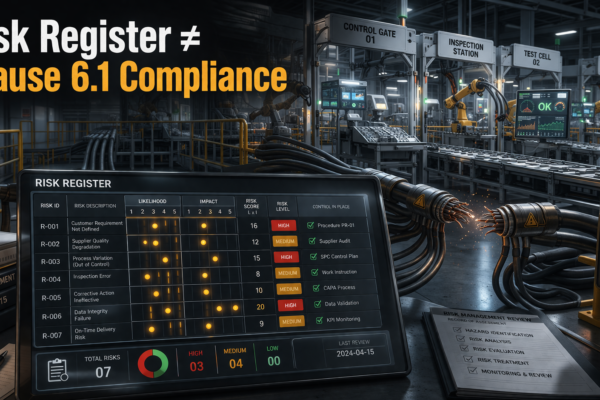
Your Risk Register Doesn’t Satisfy ISO 9001 Clause 6.1 — Here’s What Does
Most ISO 9001 risk registers list risks without changing anything downstream. Clause 6.1 conformance requires traceable integration into process controls and quality objectives — a gap ISO DIS 9001:2025 will make structurally visible.
Read article →

Your Hazard Analysis PRP Baseline Is Wrong — FSSC 22000 V7 Will Expose It
ISO 22002:2025 replaces the PRP baseline underpinning most ISO 22000 hazard analyses. When FSSC 22000 V7 mandates the new reference, every unreconstructed hazard analysis faces scope invalidation at the PRP–oPRP–CCP categorisation interface.
Read article →

Your ISO 22301 BIA Passed Certification. It Doesn’t Reflect Your Organisation Anymore.
Most ISO 22301 BIAs are accurate at certification and rubber-stamped thereafter. Clause 8.6 now gives auditors a direct mechanism to challenge whether your BIA is fit for purpose — not just whether it was reviewed on schedule.
Read article →
ISO 9001 Clause 4: The Certification Box-Tick That Becomes a Transition Liability
Most organisations certified to ISO 9001:2015 completed their ISO 9001 Clause 4 documentation once — at initial certification — and have not meaningfully updated it since. The context…
Read article →