

Your environmental aspect register covers what happens inside the site boundary. Raw material sourcing, product end-of-life treatment, downstream disposal — absent. Not because your organisation assessed those stages and concluded it had no control or influence. Because the ISO 14001 life cycle perspective requirement in Clause 6.1.2 was read as optional context rather than a mandatory analytical lens.
That reading is defensible only if the documented analysis behind it actually exists. For most certified organisations, it doesn’t.
What ISO 14001 Clause 6.1.2 Actually Requires
ISO 14001:2015 Clause 6.1.2 requires organisations to determine the environmental aspects of their activities, products, and services that they can control and those they can influence — “considering a life cycle perspective.”
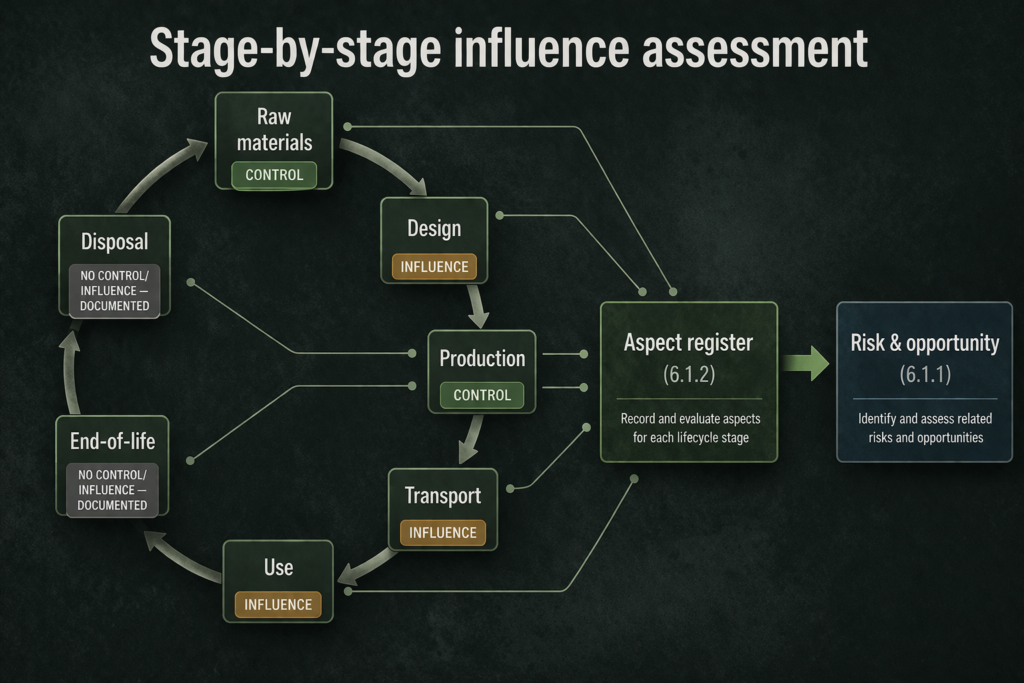
The life cycle stages are defined in Clause 3.3.3: acquisition of raw materials, design, production, transportation and delivery, use, end-of-life treatment, and final disposal. Annex A6.1.2 confirms that no detailed life cycle assessment is required. Thinking carefully about which stages can be controlled or influenced is sufficient.
That last sentence is where the misinterpretation takes root.
TC 207/SC 1 — the ISO subcommittee responsible for ISO 14001 — published reviewed interpretations in March 2024 that clarify the obligation precisely. “Consider” means the organisation must think about the topic, but it can be excluded. This is distinct from “take into account,” which means the topic cannot be excluded.
Read together, the requirement produces a two-part obligation: document your consideration of each life cycle stage, and where you exclude a stage, provide evidence supporting the exclusion. The permission to exclude is not a permission to ignore.
Where Organisations Fail on Life Cycle Aspects
BSI identified the dominant pattern in their lifecycle whitepaper: most organisations default to what sits inside the physical boundaries of an operational site and everything inside that perimeter. Supplier environmental performance, transport emissions, end-user disposal impacts — left out of EMS scope with no documented boundary decision.
BSI stated the audit consequence directly: where areas such as suppliers, transport, or end-user disposal remain out of scope, the conscious decision to exclude those factors may need supporting with further evidence.
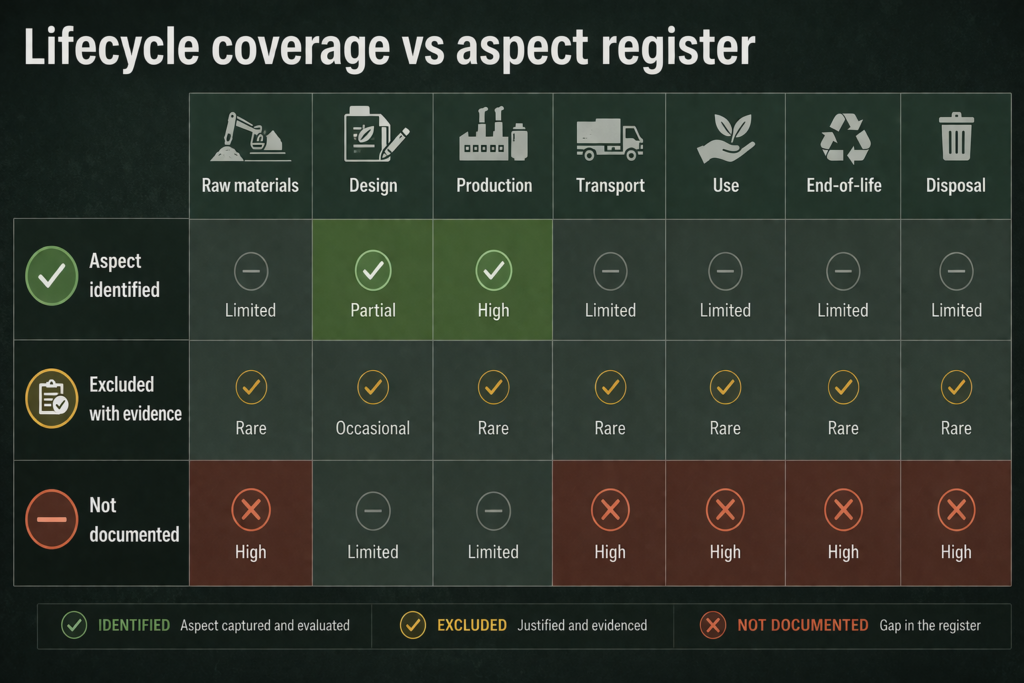
This is the gap. Not that organisations excluded upstream and downstream stages — but that they excluded them without any documented rationale. The aspect register contains no entry for procurement-stage impacts, and no written analysis concluding that procurement falls outside the organisation’s control or influence. The stage simply doesn’t appear.
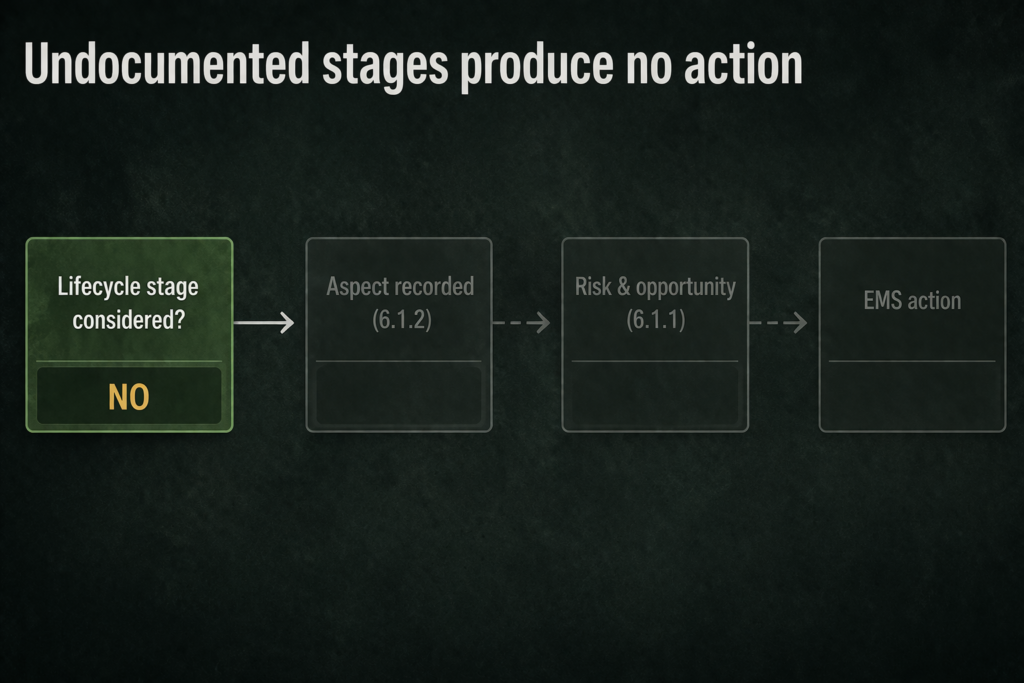
The downstream system failure is automatic. Clause 6.1.1 requires the organisation to determine risks and opportunities arising from environmental aspects identified under Clause 6.1.2. Aspects absent from the register generate no risk or opportunity actions. Procurement-related environmental risks, end-of-life liability exposure, supply chain sustainability pressures — none of these enter the EMS planning process because the input data was never captured.
The Coverage Gap That Enables the Misinterpretation
Search across TC 207/SC 1 interpretation documents, BSI lifecycle guidance, and certification body audit tools turns up nothing: no published source provides a minimum scope methodology for applying the life cycle perspective to Clause 6.1.2 aspect identification. No T1 source defines which upstream or downstream stages must be documented as considered versus which are genuinely outside the organisation’s influence.
BSI confirmed the conceptual boundary — “thinking carefully… is sufficient” — but provided no threshold criteria, decision framework, or minimum stage checklist. The TC 207/SC 1 2016 lifecycle perspective document confirmed that all stages from raw material acquisition to final disposal are in scope for consideration but did not define when “no control or influence” is a valid conclusion.
Without a common reference point, auditors lack a benchmark for what “documented consideration” should look like. That is why the misinterpretation survives audit after audit — not because it’s defensible, but because enforcement has no agreed floor. The gap is real, and naming it matters. It explains why so many registers pass unchallenged. It does not, however, absolve organisations from the obligation the current standard already imposes.
What an Audit-Defensible Life Cycle Perspective Looks Like
Closing the life cycle perspective gap does not require a full life cycle assessment. It requires a documented influence assessment — stage by stage — with written conclusions.
Audit Your Current Aspect Register Against All Seven Life Cycle Stages
For each activity, product, or service within EMS scope, map against the stages defined in Clause 3.3.3. Flag any stage with no aspect entries and no documented exclusion rationale. Every blank cell without a written boundary decision is audit exposure under the current edition.
Produce a Documented Influence Assessment for Each Flagged Stage
For procurement: does the organisation specify environmental requirements to suppliers? Can purchasing volume or contract terms influence supplier environmental performance? For end-of-life: does product design affect disposal options? Can labelling or customer instructions influence end-of-life treatment? Documented “no control and no influence” conclusions are audit-defensible. Undocumented omissions are not.
Integrate New Life Cycle Stage Aspects into Clause 6.1.1 Actions
For any upstream or downstream aspects newly identified through the influence assessment, generate corresponding risk and opportunity entries traceable to Clause 6.1.1. Without this linkage, newly identified aspects remain disconnected from EMS planning — the register expands but the system doesn’t respond.
Why This Matters Now
ISO 14001:2015 has been in service for over a decade. TC 207/SC 1 operates on a standard review cycle, and revision activity for the 2015 edition falls within the expected window. If a future edition strengthens “considering” to “take into account” — a shift TC 207/SC 1 has already defined as determinative in their interpretation framework — every aspect register built on the narrow reading becomes structurally non-conformant at the first transition audit.
Organisations that build documented life cycle boundary analyses now gain two things: audit defensibility under the current edition, and transition readiness for a potential revision that hardens the requirement. Those that wait face a compounding problem. An undocumented gap in the current system — exposed by a new edition that no longer permits the ambiguity.
Key Takeaway
The ISO 14001 life cycle perspective in Clause 6.1.2 is not optional context. It is a mandatory analytical lens that requires documented consideration of every stage from raw material acquisition to final disposal. Exclusion is permitted — but only with written evidence that no control or influence exists. Aspect registers that simply omit upstream and downstream stages without that documented analysis carry audit exposure today and transition risk tomorrow. The fix is not an LCA — it is a stage-by-stage influence assessment with written conclusions, and it should already be in your EMS documentation.
About AEC International
AEC International provides ISO 14001 certification, training, and consultancy services at the intersection of environmental management, regulatory compliance, and operational excellence. We support organisations across industries in achieving and maintaining ISO certification — from gap analysis and implementation through audit preparation and continual improvement.
Learn more: www.aec.llc